
From message to action: how specialized agents operate in a multi-agent AI assistant
Today, conversational assistants based on agentic AI no longer only answer informational queries in natural language—what was their original function—but can also perform operations or execute tasks by following the user’s or customer’s instructions. This evolution is key for many companies, as it opens the door to a new model of customer relationship and enables customers to manage their affairs in an easier and more intuitive way.
In a previous article we described the role of the routing agent or classification agent, a central component and “decision center” of the AI assistant. Its main function is to classify the customer’s query and route it to the most suitable agent, but it can also ask for clarifications when it needs more information (clarification function) or redirect the conversation when the query falls outside the banking domain (fallback function). As we saw, this intermediate triage step is what makes it possible to build a more efficient and scalable multi-agent AI assistant.

Now we will focus on the specialized agents that are part of Blue: AI agents that are experts at solving specific tasks and that are activated once the routing agent has been able to precisely identify the banking operation the customer wants to carry out.
Before diving into how these AI agents work, it is important to remember that, for our assistant, a banking operation is any process that requires accessing the customer’s specific information. Making a money transfer or checking the available balance in the bank account are examples of banking operations.
The role of specialized AI agents
A customer sends a message through Blue. Immediately, the routing agent tries to identify the customer’s query and classify it as a specific operation or as an information request. If it is an operational query, the routing agent forwards the message and all the information gathered to the corresponding AI agent.
To resolve the different banking operations, Blue has a modular architecture based on specialized agents. Each of these agents is designed to manage one of the more than 150 operations available in the system. In other words, there are as many specialized agents as there are operations available.
These specific agents also interact with the customer to gather additional information when necessary, verify the context and, ultimately, execute or facilitate the corresponding operation.
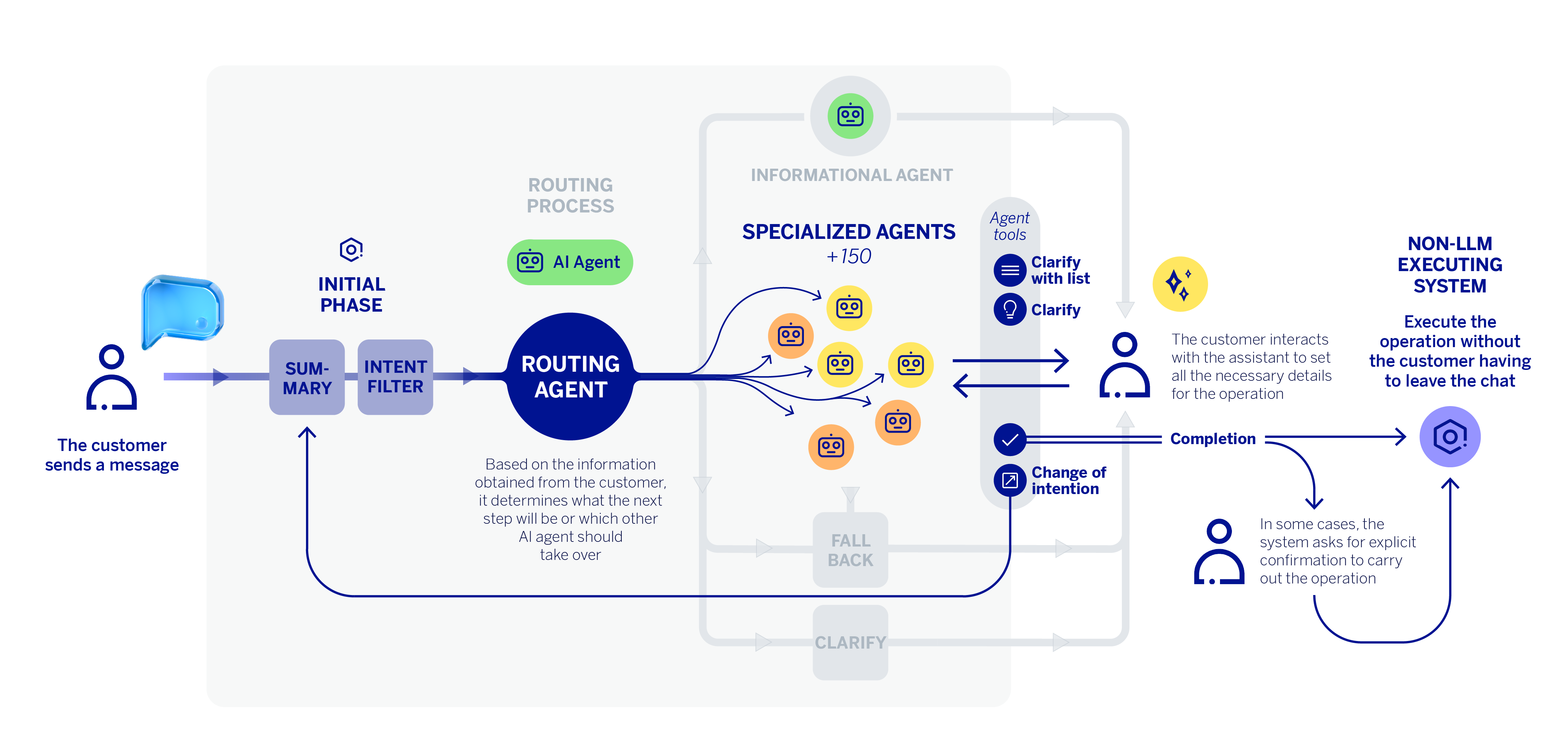
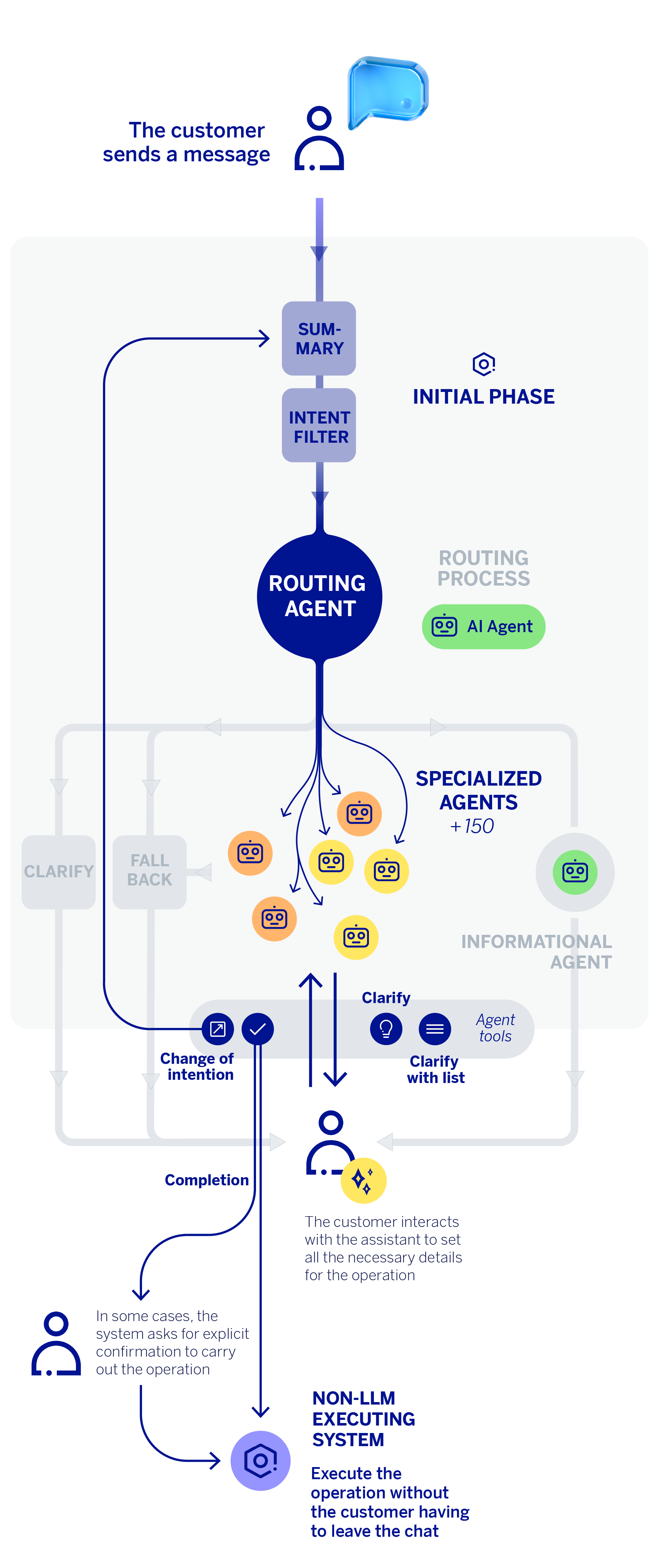
It is worth noting the main responsibility of this conversational system, based on a large language model (LLM), is to collect the necessary information to carry out each operation. However, it is not this system that executes the operation directly. In fact, structured information is transferred to another independent system that first displays it to the customer in a visual, clear way that is adapted to the app environment, and then executes it. This guarantees a more comfortable and intuitive user experience.
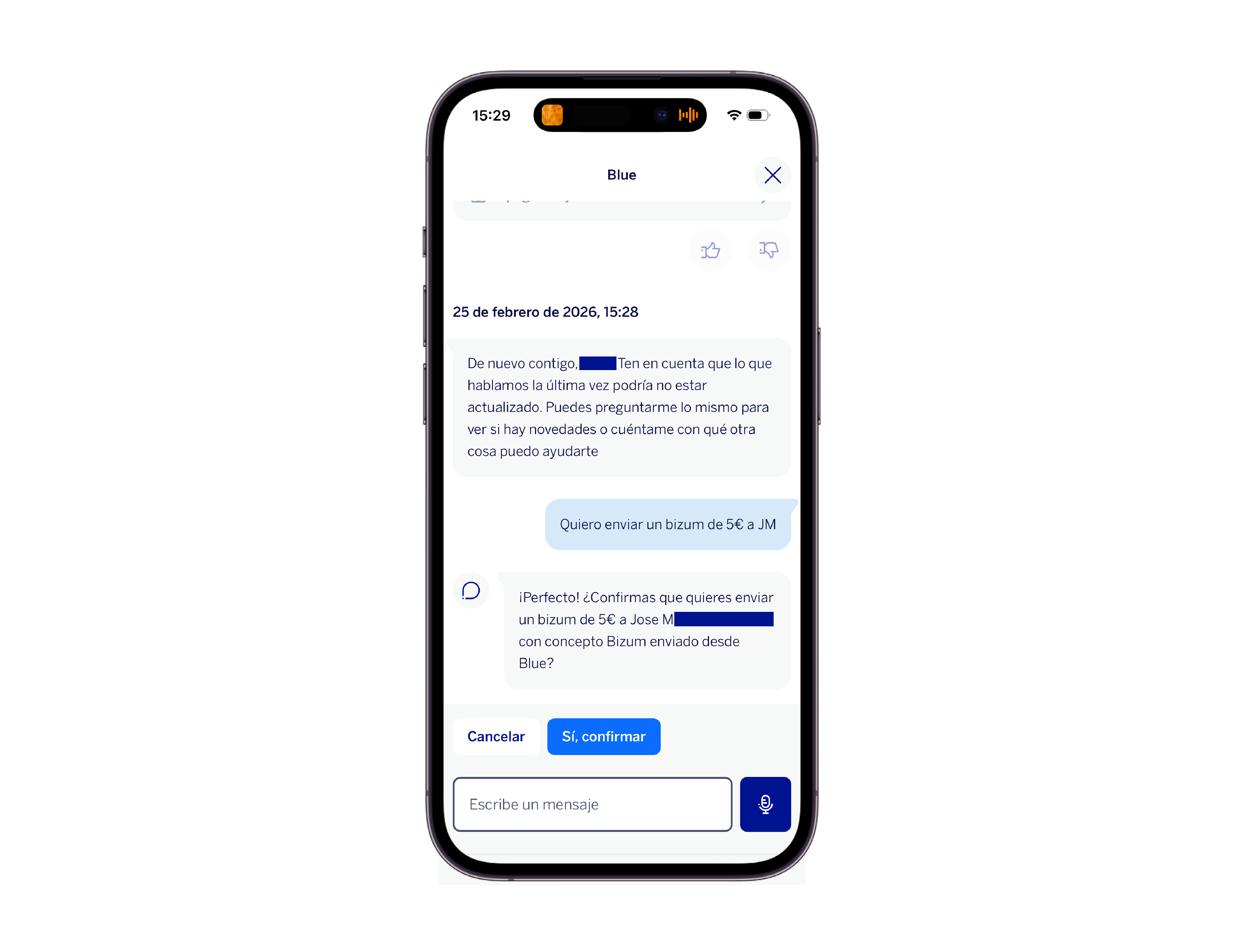
Additionally, for operations that directly affect the customer’s money —such as transfers or other payments— the process always includes a final step of explicit confirmation, similar to what happens when performing this type of operation from its specific section in the BBVA mobile app. In this way, the customer must confirm the final decision before any operation is completed, reinforcing the security and transparency of the process.
The ultimate purpose of specialized agents is to offer customers the ability to manage tasks without leaving the conversational interface. Although this is already possible for many banking operations in Blue, there are others that require some additional steps. Below we describe the main types of specialized agents, according to their behavior and the response they provide to the customer.
End-to-end (E2E) operations: solving tasks without leaving the assistant
End-to-end (E2E) operations are those carried out entirely from the conversational interface, i.e., without redirecting the customer outside the chat. To execute these types of operations we rely on the most sophisticated agents, which integrate both business logic and contextual interaction capabilities. Each of these specialized agents has three key elements:
| Behavior prompt |
| Defines the agent’s role and instructions, including when to ask for clarifications, handle exceptions and complete the operation. |
| Entities |
| Information that the customer must provide to complete the operation. Some are mandatory (e.g., the amount in a Bizum/instant payment), others optional (e.g., the message/description of the transfer). |
| Tools |
|
Functions that the LLM can invoke to execute the operation. The main tools are:
|
| Behavior prompt |
| Defines the agent’s role and instructions, including when to ask for clarifications, handle exceptions and complete the operation. |
| Entities |
| Data the customer must provide to complete the operation. Some are mandatory (e.g., the amount in a Bizum/instant payment), others optional (e.g., the message/description of the send). |
| Tools |
|
Functions that the LLM can invoke to execute the operation. The main tools are:
|
The agent remains in the conversation until it can invoke the completion tool or until it detects an intent change that requires rerouting the flow.
E2E use case: the Bizum operation
The specialized Bizum AI agent (instant mobile payment) is one of the most used, specially in Spain. It allows the customer to select the contact to whom the payment will be sent and execute the money transfer without leaving the chat. To reinforce the security and transparency of the process, in its final stretch the assistant shows the payment information that will be carried out and displays a button that the customer must click to confirm the transaction.
One of the main challenges we faced with the Bizum agent was working with customers’ contact lists, which can vary greatly in size. Sending a very large contact list to an LLM can create response-time, computational cost and performance issues. For this reason, we have incorporated a prior contact-filtering process over the customer’s entire contact list, which is triggered before the specialized Bizum agent takes action.
First, the customer makes a query that includes basic information about the Bizum recipient. With this information, we call another LLM to generate an SQL query, with which we filter the contact list and obtain a subset of contacts —those that are most related to the information provided by the customer—.
Next, the specialized Bizum agent chats with the customer to obtain the final contact, the amount of money to send and, optionally, the concept/message.
This approach is highly scalable and makes it possible to offer a smooth experience regardless of the size of the customer’s contact list. It is already available to all customers and is delivering very positive results.
Specialized AI agents that redirect to other areas of the BBVA app
Not all banking operations are yet enabled for full conversational resolution. For those where end-to-end logic has not been implemented, specialized agents were designed to propose a solution: provide a link that redirects the customer to the corresponding section of the application, where they can complete their request.
Specialized AI agents for product-linked operations
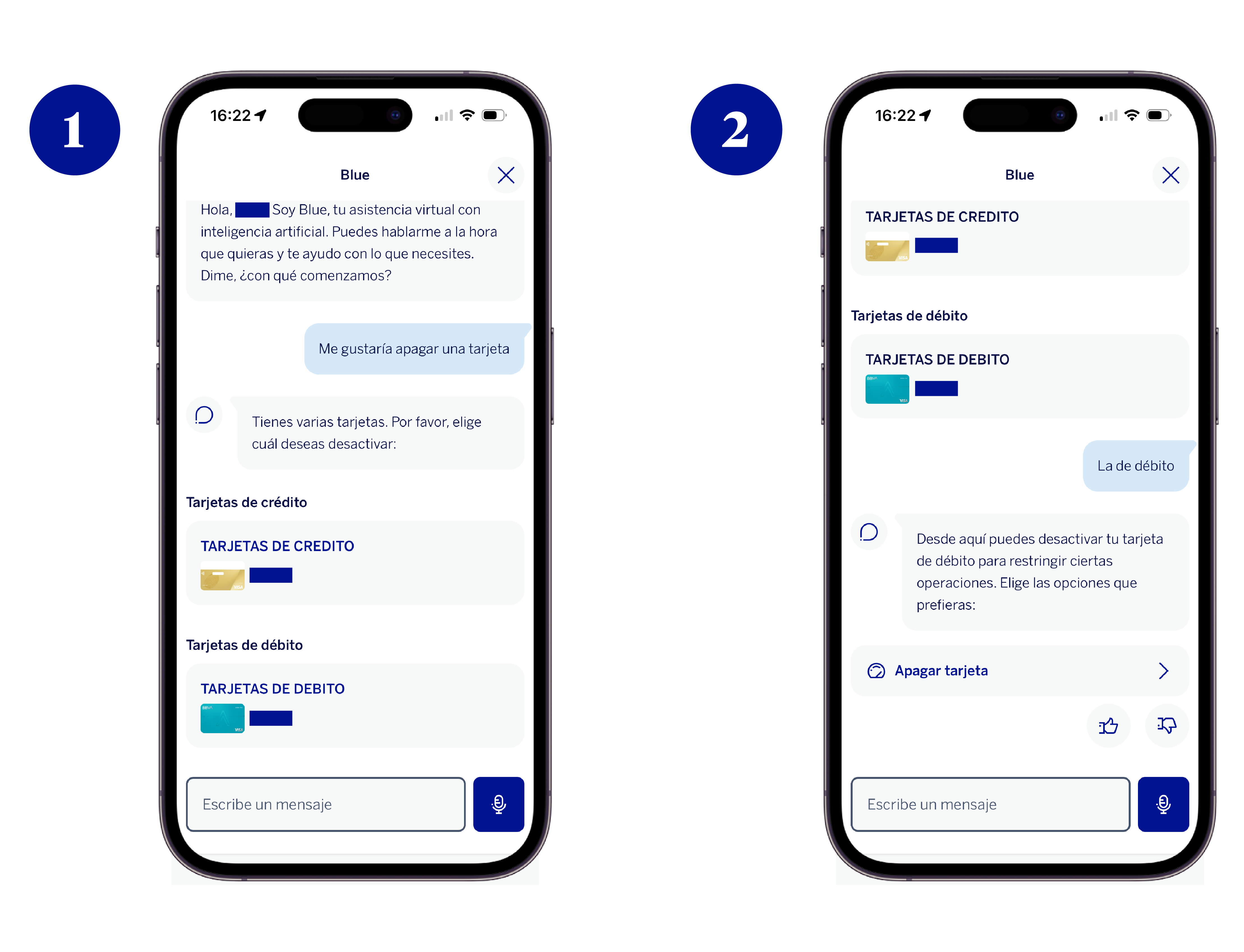
Within these AI agents, we observe a first category of product-linked operations. In these cases, it is necessary to identify beforehand the product on which the customer wants to act —for example, which card they want to cancel–. To do this, the agent initiates a brief conversation with the customer using the same clarification, completion and change tools as in end-to-end operations. Once the product is identified, the corresponding link to the requested operation is shown.
Specialized AI agents for operations with no associated product
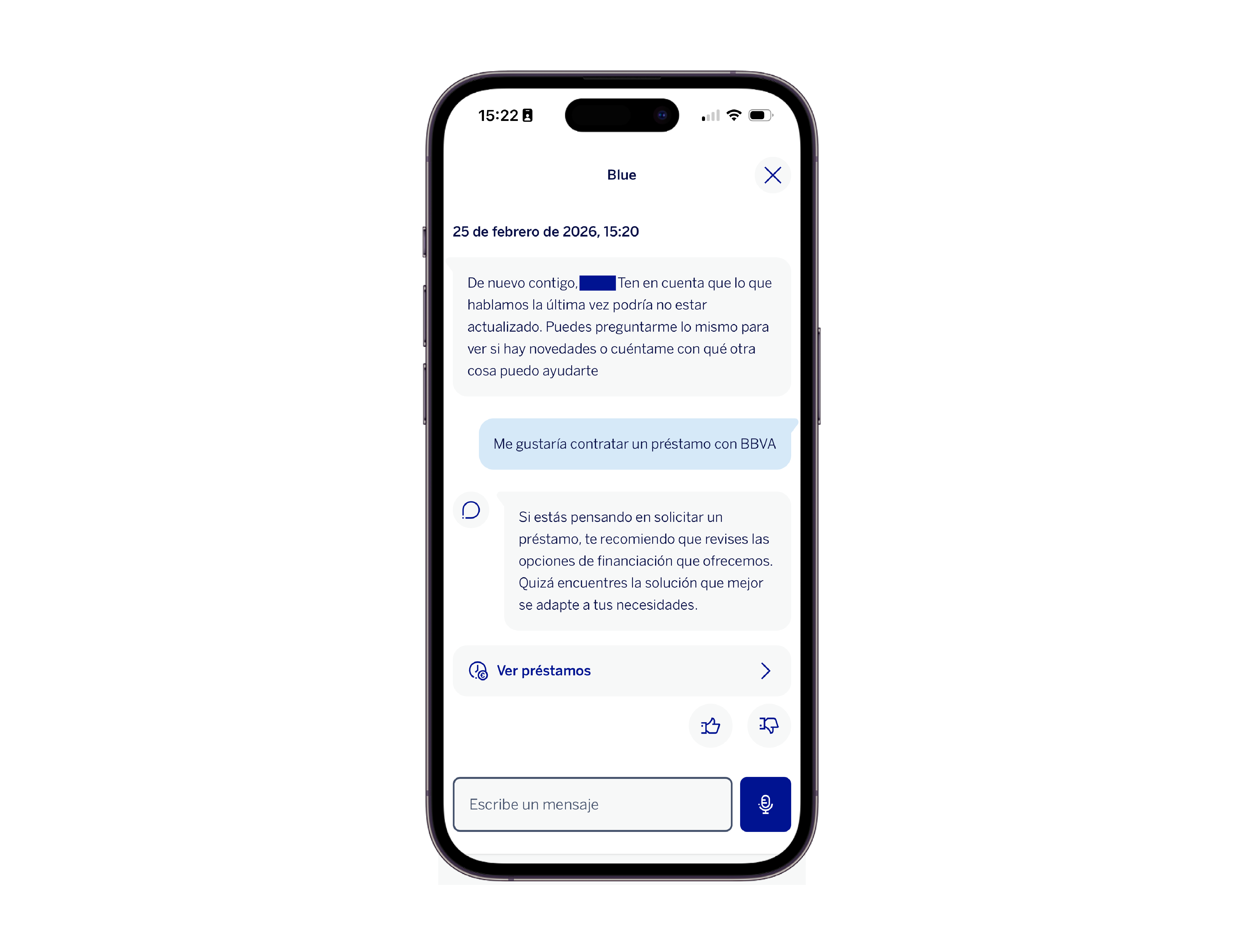
These are operations in which the specialized agent does not need to identify any product to continue the process. Once the customer’s intent is detected, the agent directly presents the link that allows the management to be completed outside the conversational channel. This happens, for example, when the customer expresses their intention to contract a new product through Blue, such as a mortgage or a loan. In these cases, there is still no product on which an operation can be carried out —because the operation is, in fact, contracting the product–.
The future of AI assistants: towards 100% conversational coverage
BBVA’s AI assistant, Blue, is able to carry out banking operations guided by the customer. In this article we have focused on the different types of specialized operation agents, with special attention to the Bizum agent, as it is one of the most used by our customers.
The main advantage of this modular architecture based on specialized AI agents lies in its ability to perform more than 150 banking operations accurately and swiftly, many of which can be resolved without the need to leave the conversational interface. The intention going forward is to progressively migrate all agents to an end-to-end format, so that more and more operations can be resolved entirely from within the chat itself. This not only improves the user experience by eliminating redirects, but also offers a smoother and more personalized interaction.